Receive
Confirm carton and tote quality, scan events and put-away batching before trays absorb damaged or oversize units.
Connect tray payload, SKU velocity, pick faces, fire and maintenance aisles, WMS/WCS handshakes and recovery access before you freeze a dense storage concept. Modula helps operations, maintenance and controls teams review the same evidence set.
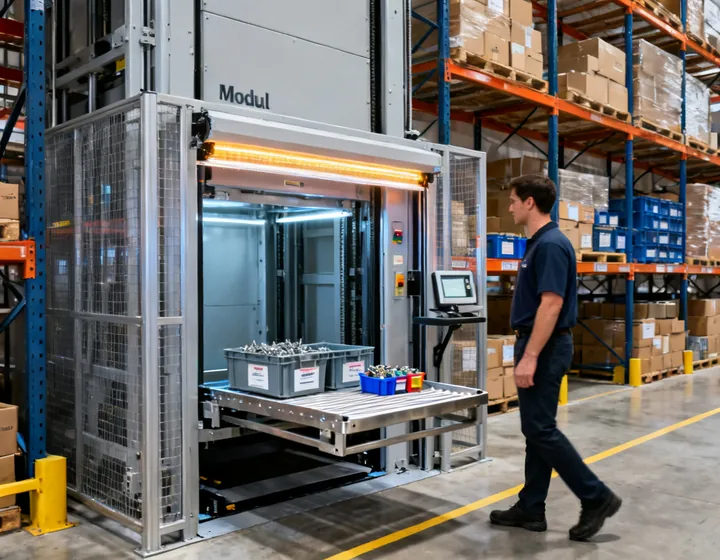
A vertical lift module or AS/RS bay is not an island. Each decision changes receiving presentation, buffer occupancy, pick rate, replenishment and exception recovery.
Confirm carton and tote quality, scan events and put-away batching before trays absorb damaged or oversize units.
Balance inventory cube utilization with selectivity, fire aisles, maintenance access and future expansion slots.
Define tray travel, buffer positions and handoff points so accumulation does not hide a blocked pick face.
State order lines per hour with SKU mix, tray dwell, confirmation method and goods-to-person ergonomics.
Clarify whether trays feed wave staging, put walls or direct pack so divert logic stays ownership-clear.
Document cutover windows, fallback states and restart authority so live shipping survives commissioning.
Confirm carton and tote quality, scan events and put-away batching before trays absorb damaged or oversize units.
Review inbound interfaces →Balance inventory cube utilization with selectivity, fire aisles, maintenance access and future expansion slots.
Review dense storage →Define tray travel, buffer positions and handoff points so accumulation does not hide a blocked pick face.
Review tray movement →State order lines per hour with SKU mix, tray dwell, confirmation method and goods-to-person ergonomics.
Review pick faces →Clarify whether trays feed wave staging, put walls or direct pack so divert logic stays ownership-clear.
Review interface ownership →Document cutover windows, fallback states and restart authority so live shipping survives commissioning.
Review phased go-live →Use the matrix as a discussion starter, then replace assumptions with site data, temperature limits and an agreed peak window.
High SKU count with volatile A/B/C bands; sharp evening peaks; ambient totes and small cartons.
Medium depth with frequent replenishment; wave-based peaks; ambient or chilled cases and mixed trays.
Constrained access windows; door-open limited peaks; chilled or frozen insulated totes.
Parts kits and spares; shift-change spikes; ambient or clean-zone bins and fixtures.
Multi-client segregation; contract-driven peaks; mixed temperatures and pallet/tote hybrids.
Even partial tray, SKU and interface facts can reveal the next measurement or stakeholder decision. Modula can organize the record without treating early assumptions as final specifications.